
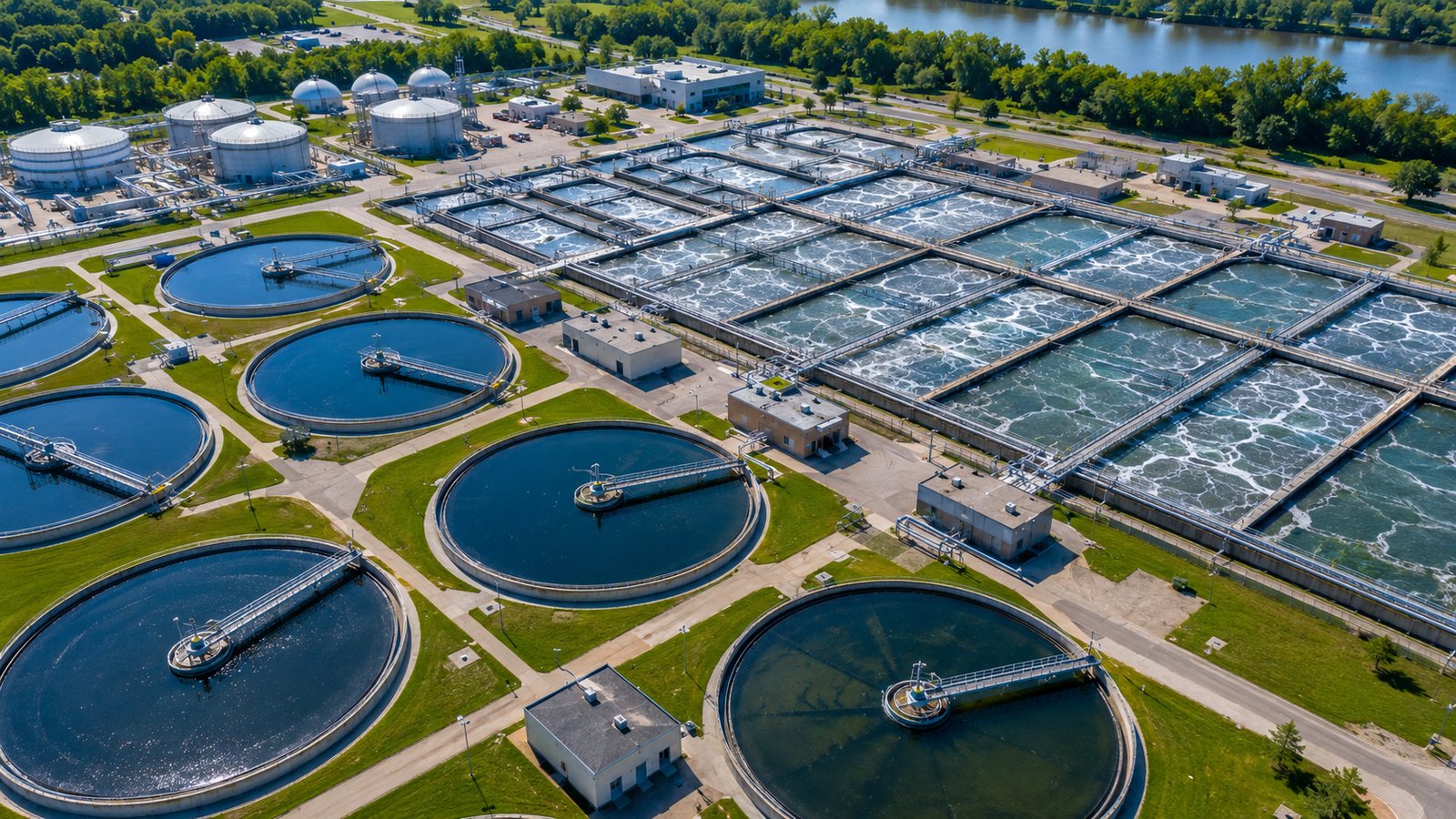
Municipal & Industrial Water Treatment Research
Field studies and technical documents on dissolved-metal removal, ozone-system enhancement, biocide performance, and regulatory approvals.
Approved, certified & independently validated
 EPA FIFRA
Registered
 USDA Organic
Certified
 NSF/ANSI
Standard 60
Highlights
Proven results in municipal and industrial plants.
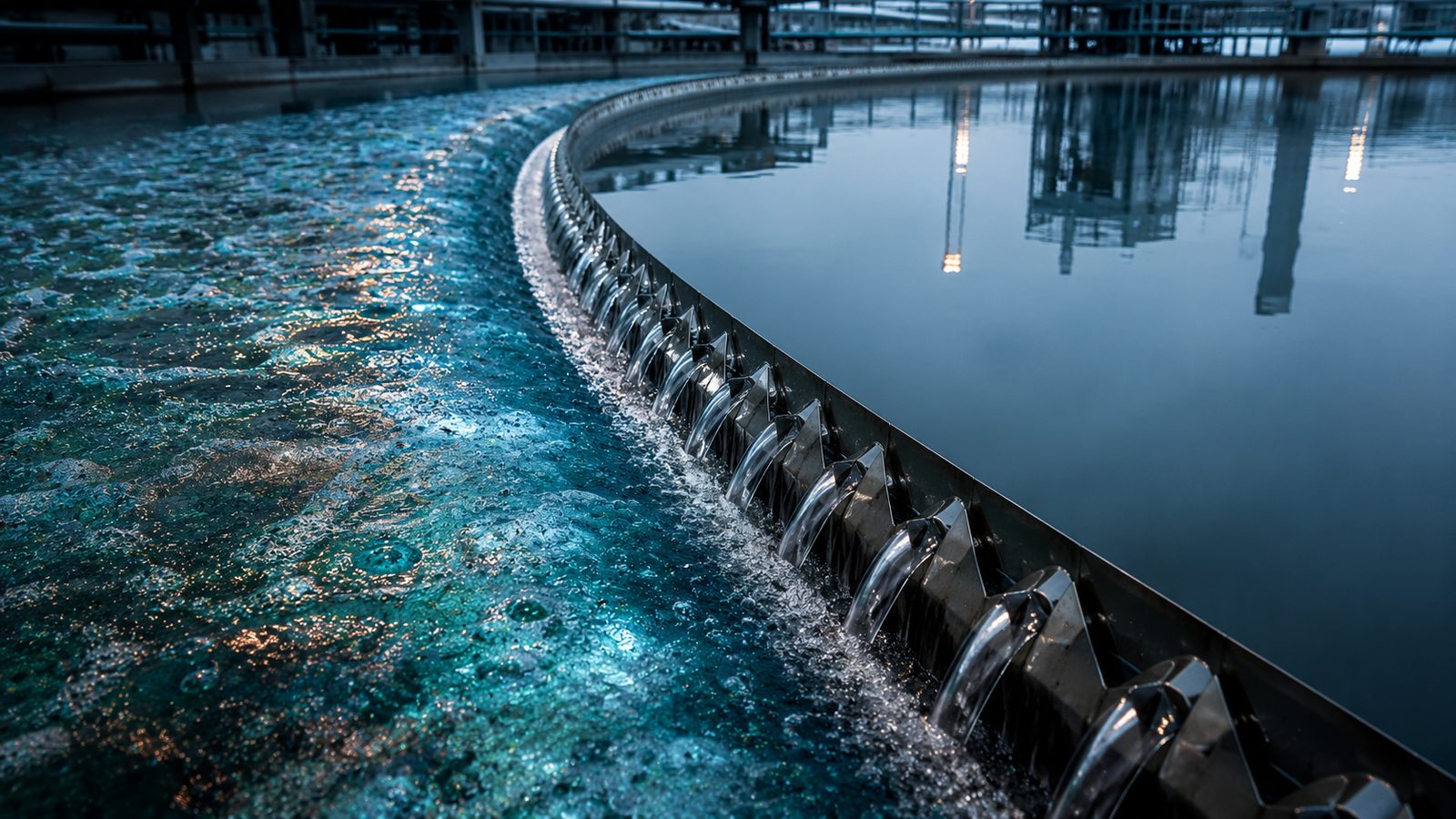
Case study — dissolved metals
Meeting a 3.1 ppb copper limit at full scale.
A municipal wastewater plant in the Sierra foothills of Northern California faced influent dissolved copper of 28 to 70-plus ppb and was exceeding its 3.1 ppb discharge limit, confirmed by a Water-Effect Ratio study. Jenfitch deployed a two-product program over a full one-year trial.
- JC 9830 metal precipitant dosed at 10 mg/L into the aeration-basin discharge, forming a copper-sulfide precipitate.
- JC 1687 cationic coagulant dosed at 10 mg/L at the secondary-clarifier inlet, building dense, fast-settling floc.
- Result: 94% dissolved copper and roughly 70% dissolved zinc removed, with effluent copper held below 1.4 ppb — well under the 3.1 ppb limit, and non-detect (<0.5 ppb) in other trials.
Results data
Copper & zinc removal by sample date.
| Sample date | Influent Cu (ppb) | Effluent Cu (ppb) | Cu removal | Zn removal |
|---|---|---|---|---|
| March 11 | 35 | 2.0 | 94.3% | 68.9% |
| March 15 | 28 | 1.6 | 94.3% | 79.8% |
| March 30 | 58 | 1.4 | 97.6% | 76.0% |
| August 16 | 46 | 3.8 | 91.7% | 56.3% |
The chemistry
Why sulfide precipitation beats hydroxide.
Conventional metal removal relies on raising pH to precipitate metal hydroxides. Copper hydroxide is amphoteric — it dissolves again at both low and high pH — so removal is only optimal in a narrow window (about pH 8.1 for copper). It also generates excessive, hard-to-dewater sludge, and natural chelating agents in the wastewater can block hydroxide precipitation entirely.
Jenfitch instead precipitates copper as a sulfide. Copper sulfide has far lower solubility than the hydroxide, precipitates cleanly over a broad pH range, and forms a dense floc that dewaters easily. It works even in the presence of chelating agents that defeat hydroxide chemistry — delivering higher, more consistent removal. The same program also reduces hexavalent chromium to the less toxic trivalent form.
Paired coagulant
JC 1687 is a cationic organic/inorganic coagulant that neutralizes particle charge and binds the fine metal-sulfide precipitate into dense floc, sharply improving settling in the secondary clarifier.
Field study — ozone enhancement
Rescuing an aging surface-water ozone system.
At a surface-water treatment plant, Jenfitch reactive oxygen species (ROS) chemistry was introduced to support an ozone system nearing the end of its service life. Rather than replacing the ozone generators — a capital project estimated at more than $20 million — the plant improved finished-water quality by supplementing oxidation with mineral-oxychloride ROS.
- Lower bromate formation in the finished water.
- Reduced total organic carbon (TOC).
- Lower total trihalomethanes (TTHMs) and HAA5 disinfection by-products.
- Avoided a >$20MM ozone-system replacement.
Questions
Common questions — municipal & industrial
How does the copper program meet strict discharge limits?
JC 9830 precipitates dissolved copper as copper sulfide, which has very low solubility and precipitates over a broad pH range. Paired with the JC 1687 coagulant for settling, the program removed 94% of dissolved copper and held effluent below 1.4 ppb against a 3.1 ppb limit in a full-scale one-year trial.
Why not simply raise pH to precipitate hydroxides?
Metal hydroxides are amphoteric and re-dissolve outside a narrow pH window, produce large volumes of hard-to-dewater sludge, and can be blocked by natural chelating agents. Sulfide precipitation avoids all three problems and yields denser, easier-to-dewater solids.
Can ROS work with an existing ozone system?
Yes. In the surface-water field study, ROS supplemented the existing ozone process, lowering bromate, TOC, TTHMs and HAA5s while avoiding a >$20 million ozone-generator replacement.
Are these products approved for water use?
JC 9465 is EPA FIFRA registered and USDA NOP organic certified; JC 9450 is NSF/ANSI Standard 60 certified for drinking-water treatment. Labels and approvals are linked in the Documents section below.
Documents