

Oil & Gas
Lift stripper-well output, eliminate H₂S and iron sulfide, and treat produced water — with ozone-class oxidation that leaves a residual.
Jenfitch treats oil and gas water with JC 9450 and JC 9465, mineral oxychloride chemistry that generates reactive oxygen species reacting with H2S, iron sulfide, biofilm, and paraffin while breaking produced-water emulsions. In a Pecos County, Texas field study, 5 gallons per day into the casing lifted wells from 1-2 to 15 barrels per day.
Challenges We Solve
What holds a well back?

Stripper-Well Economics
A stripper well averages 15 bbl/day or less (typically 1–2). The NSWA counts 770,000+ US stripper wells — 11.3% of US oil and 8.3% of gas — yet 50–70% of the oil beneath them is unrecoverable due to pressure, permeability, and paraffin.
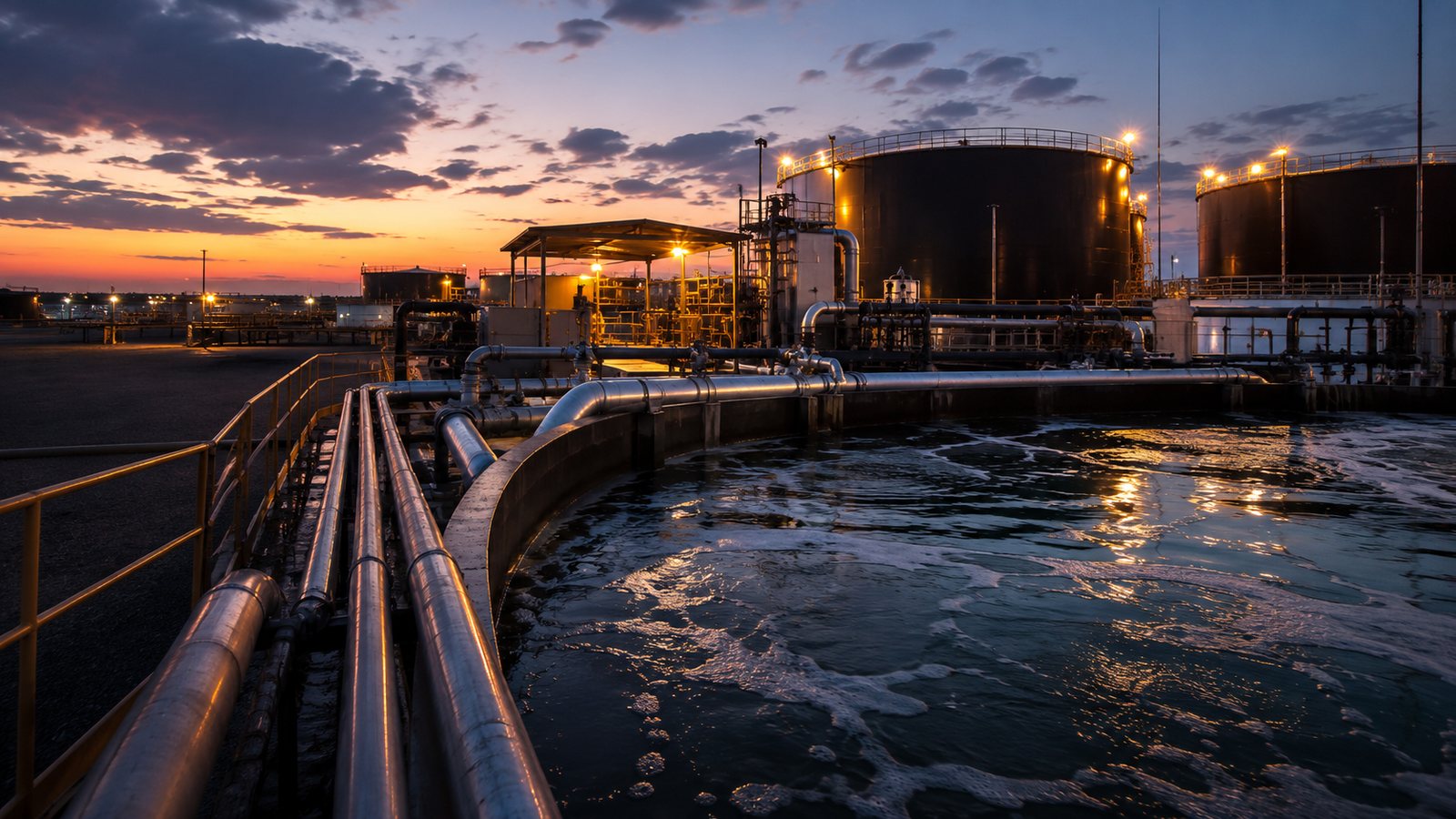
H₂S, Iron Sulfide & Produced Water
Sour gas (>10 ppmv H₂S), iron-sulfide fouling, downhole biofilm, and paraffin/asphaltene deposition — plus produced water that needs emulsion breaking and polishing.
How Jenfitch Treats It
How does ROS work downhole and topside?
JC 9450 (and flagship JC 9465) generate reactive oxygen species from mineral oxychloride chemistry that react with H₂S, iron sulfide, biofilm, and bacteria, act as an emulsion breaker and micro-flocculant for produced water, and destabilize paraffin and asphaltene. Because the oxidation carries a lasting residual — unlike ozone, which dissipates — protection persists downhole and through the gathering system.
For oily-water polishing, our organo-clay technology adsorbs oil, grease, and hydrophobic organics ahead of membranes or carbon. In a Pecos County, Texas field study (Feb 2020, four wells), 5 gal/day of JC 9450 into the casing lifted wells from 1–2 bbl/day to 15 bbl/day for under $100/day, eliminating H₂S in gas and liquid and leaving produced water with no detectable iron, bacteria, or H₂S.
A residual ozone can't match
Mineral oxychloride delivers ozone-class oxidation (2.8–2.9 V) but holds a residual, so treatment keeps working after injection rather than dissipating like a dissolved gas.
Proven Results
Field numbers from the oil patch.
A side-by-side comparison (Well 10 with JC 9450 vs Well 12 control) estimated 33.5 vs 19.5 bbl/day — a 72% gain — with treatment in 4 hours versus 4–7 days conventionally and material cost of $9,600 vs $11,100. In a Houston wet-scrubber study, a natural-gas stream carrying 2,000 mg/L H₂S with 5% CO₂ achieved complete H₂S elimination, an ORP shift from −150 to +100 mV, and only inert sulfate residuals.
| Metric | JC 9450 (Well 10) | Control (Well 12) |
|---|---|---|
| Estimated output | 33.5 bbl/day | 19.5 bbl/day |
| Treatment time | 4 hours | 4–7 days |
| Material cost | $9,600 | $11,100 |
| Bottle-test bacteria | <1K CFU | <10K CFU |
Approved & validated
 EPA FIFRA
Registered
 USDA Organic
Certified
 NSF/ANSI
Standard 60
Frequently Asked Questions
Oil & gas program questions.
How much can output improve on a stripper well?
In a Pecos County, Texas field study, 5 gal/day of JC 9450 into the casing lifted wells from 1–2 bbl/day to 15 bbl/day for under $100/day. A side-by-side comparison estimated a 72% output gain (33.5 vs 19.5 bbl/day) over an untreated control.
Does it eliminate H2S and sour gas?
Yes. In a Houston wet-scrubber study, a natural-gas stream carrying 2,000 mg/L H2S with 5% CO2 achieved complete H2S elimination at $0.0040/lb removed, with an ORP shift from -150 to +100 mV and only inert sulfate residuals. Sour gas here means a stream above 10 ppmv H2S, so that loading sat far above the threshold. The ORP shift is the control signal, and the sulfide is oxidised through to sulfate rather than moved to another phase.
What about iron sulfide, biofilm, and paraffin?
The ROS chemistry reacts with H2S, iron sulfide, biofilm, and bacteria, and destabilizes paraffin and asphaltene, and treated produced water showed no detectable iron, bacteria, or H2S. In a Pecos County, Texas field study covering four wells, 5 gal/day of JC 9450 into the casing eliminated H2S in both gas and liquid. Iron-sulfide fouling, downhole biofilm, and paraffin deposition all restrict flow, so one feed addresses several deposits at once.
How is this different from ozone treatment?
Mineral oxychloride delivers ozone-class oxidation (2.8-2.9 V) but carries a lasting residual, so protection persists downhole and through the gathering system rather than dissipating like a dissolved gas. Ozone has to be generated and dissolved at the point of use, so its effect ends near where it is introduced. Because the mineral oxychloride residual travels with the fluid, H2S, iron sulfide, and biofilm control continues past the injection point.
Can you treat produced water?
Yes. JC 9450 acts as an emulsion breaker and micro-flocculant, and our organo-clay technology adsorbs oil, grease, and hydrophobic organics ahead of membranes or carbon. Breaking the emulsion releases dispersed oil so it can separate, while the micro-flocculant action binds fine solids into floc that settles. Organo-clay is organically-modified clay media, and using it as a polishing step protects downstream membranes or carbon from the organics that shorten their life.