Paraffin forms when the crude oil is flowing up to the surface and hits ambient temperature.
As the crude oil cools down, crystals form into paraffin wax.
JC 9465 was injected at a rate of 5 gallons per day. By the third day, the flow rate was checked and there was an increase of 10X from the previous flow rate.
Treatment will vary depending on a well. It may be better to treat every day with 1- 5 gallon bucket or every other day with the same amount.
There is a range of methods for removing paraffin wax build-ups in oil wells including:
Mechanical – Hot Oiling
Scraping – Hot Water
Coiled Tubing – Chemical – Wax Solvents/Dispersants
Thermal – Combination Treatments
JC 9465 is the safest, most effective and affordable method for inhibiting paraffin.
Once JC 9465 is applied, it works within minutes, not hours or days.
JC 9465 Economics
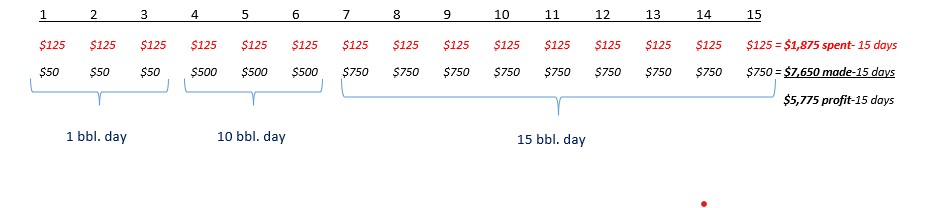
Scenario 1 (everyday application) – Crude at $50 per barre
Days (15 days shown – double numbers to get monthly figures)
Scenario 2 (every other day application) – Crude at $50 per barrel
Days (15 days shown – double numbers to get monthly figures)
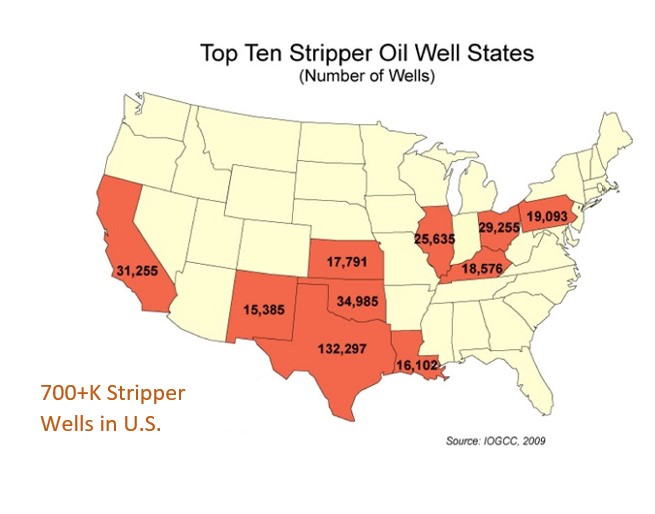
When applying JC 9465 to a crude oil production/stripper well, it is recommended to put 1 – 5-gallon bucket @ $125 ea. ($25 per gallon) into the well with 5 gallons of water to chase it. If JC 9465 is applied every day to a well that has been producing 1 bbl. per day, production should increase to 10 or 15 times that within two weeks. If applying JC 9465 every other day (Scenario 2), then the well should increase production by 10X.
There are no absolutes when inhibiting paraffin. In general, JC 9465 will break up biofilm, emulsions and increase production. The increase in production will depend on amount of product that is applied. Every day (Scenario 1) should increase production 15X. Every other day (Scenario 2) should increase production 10X.
JC 9465 Paraffin Market
The biggest paraffin deposits are in Canada and Venezuela.
The U.S., Middle East, Russia would come behind that.
There are offshore applications all over the world as well.
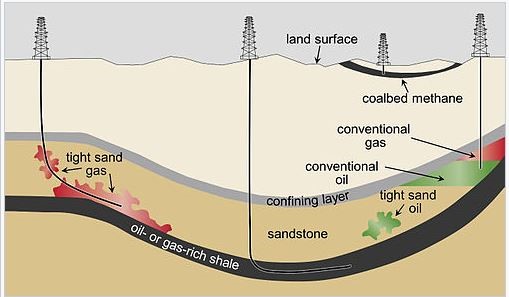
As a side note, wherever there are production wells, the fracking wells are close by.
Fracking wells are using an average of 20 million gallons of water for one well.
Paraffin and Fracking Wells are a focus for JC 9465.
In a recent study in Houston, TX, H2S was removed from a natural gas stream containing 2,000 mg/l of H2S and 5% CO2 using JC 9465 ROS. JC 9465 ROS is a new mineral oxychloride compound that generates Reactive Oxygen Species (ROS) like hydroxyl radical ions and other ions in a highly soluble form that is easy to use. The study, which simulated the operating conditions of a wet scrubber, found that the high concentration of soluble hydroxyl radical ions quickly took the ORP (oxidation-reduction potential as measured by mV) from -150 mV to +100 mV, completely eliminating the H2S. The residual materials left in the solution were inert sulfate compounds.
Sour gas and sour water are terms used to describe gas and water containing significant amounts of hydrogen sulfide (H2S). Sour water and sour gas applications are abundant at oil refineries and natural gas plants. The “sweetening” of gas and water refers to the processes used to remove H2S and organosulfide compounds. Hydrodesulfurization is a method used to remove sulfur in these applications. It is a catalytic chemical process used to capture the sulfides in natural gas and refined petroleum products including gasoline, jet fuel, kerosene, fuel oils and diesel fuel. The H2S gas is subsequently converted into elemental sulfur with the Claus Process.
One of the reasons that it is important to remove sulfides from natural gas and refined petroleum products is to reduce the sulfur dioxide emitted when the fuel is combusted in automobile engines, power plants and furnaces. The U.S. Environmental Protection Agency (EPA) has focused on SO2 as a pollutant for decades. The largest sources of SO2 emissions are from fossil fuel combustion at power plants (73%) and other industrial facilities (20%). In 2010, the U.S. EPA revised the primary SO2 National Ambient Air Quality Standards (NAAQS) by establishing a new one-hour standard at a level of 75 ppb. The EPA revoked the two existing primary standards because they would not provide additional public health protection given a one-hour standard at 75 ppb.
According to the U.S. EPA, current scientific evidence links short-term SO2 exposures, ranging from 5 minutes to 24 hours, with an array of adverse respiratory effects, including bronchial constriction and increased asthma symptoms. These effects are particularly important for asthmatics at elevated ventilation rates (e.g. while exercising or playing). Studies also show a connection between short-term SO2 exposure and increased visits to emergency departments and hospital admissions for respiratory illnesses, particularly in at-risk populations such as children, the elderly, and asthmatics.
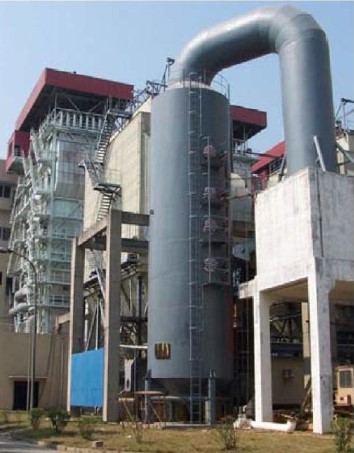
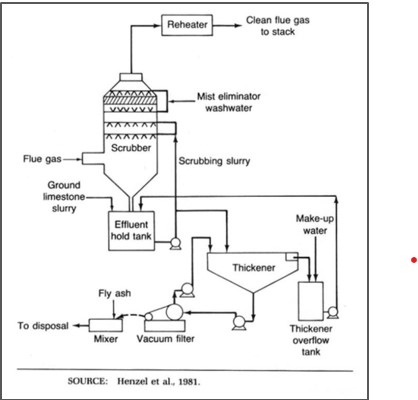
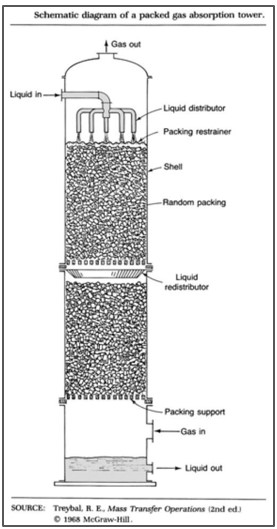
Wet scrubbing is one of the processes used to remove Nitrogen compounds (NOx) and Sulfur compounds (SOx). During this process, particulates and pollutants are removed from a gas or liquid stream through contact with a scrubbing liquid. The scrubbing liquid is typically a water-based solution that is recirculated through a sprayer at the top of a tower, with the gas stream moving up the tower from the bottom. This countercurrent flow is used to efficiently capture particulate matter and absorb specific chemicals from the gas. Acidic solutions (sulfuric acid solutions) absorb alkaline gases such as ammonia, and alkaline solutions (caustic soda, sodium hypochlorite, lime slurry) absorb acidic gases such as sulfur dioxide, carbon dioxide, and hydrogen sulfide. The goal of this treatment is to keep hydrogen sulfide below 4 mg/l. In the area of non-regenerative systems, there are four types of chemical scavengers: aldehyde-based, metallic oxide-based, caustic-based, and other processes (oxidants).
The Problem
There are many types of chemical scavengers available to use in a wet scrubber scheme. However, there are several criteria for gas and liquid treatments: 1) rapid rate of reaction, 2) non-reversible reaction path (no reversion to H2S), 3) cost efficiency per mole of H2S removed, and 4) prevention of solids formation (e.g. dithiazine).
The Solutions – Hydroxyl Radical Ions
A variety of chemical oxidizers have been used in wet scrubbers for the removal of hydrogen sulfide. How quickly and efficiently the hydrogen sulfide is oxidized is directly proportional to the oxidant’s oxidation potential. The contact time for hydrogen sulfide to react is inversely proportional to the oxidation potential of the chemical used as the oxidizer. (Note that the higher the oxidation potential, the quicker the reaction.)
Oxidation Potential of Various Oxidizers
Oxidizer
Formula
Oxidation Potential
Fluorine
NF3
3.0
Hydroxyl Radical
OH–
2.8
Ozone
O3
2.1
Hydrogen Peroxide
H2O2
1.8
Potassium Permanganate
KMnO4
1.7
Chlorine Dioxide
ClO2
1.5
Chlorine
Cl2
1.4
Oxygen
O2
1.2
Hypochlorite
OCl
0.9
JC 9465 ROS generates hydroxyl radical ions which are one of several reactive oxygen species (ROS) that meets the above criteria. It is a new low-cost technology that is easy to use in a variety of applications and systems. It will oxidize sulfur compounds to sulfur oxide or elemental sulfur. By using a simple tool, the ORP meter, and controlling treatment dosage between +100 mV to +300 mV, we eliminate H2S. JC 9465 ROS reacts quickly and will not permit reversion back to H2S or form precipitants. (Note that JC 9465 will generate elemental sulfur
[S0] if the ORP is run above +700 mV.)
The capital cost to set up a system to feed JC 9465 is low. The chemical feed system is simply a metering pump and a chemical storage tank. For a fully- automated system, you would need to install an ORP controller on the return line or in the sump. The ORP controller can be used to monitor the millivolts (mV) and control chemical dosing of JC 9465.
Below is a cost comparison of several treatment systems:
Odor Control Technologies Cost Comparison
Technology (Max H2S Conc.)
Capital Cost YR 2009
Annual O&M YR 2009
Cost per lb. of H2S Removed
Chemical Scrubber (100 ppm)*
$206,000
$148,000
$3.50
Bio-Scrubber (100 ppm)*
$383,000
$10,200
$0.24
Bio-Filter (5 ppm)*
$355,000
$65,000
$30.62
Std. Carbon Scrubber (5 ppm)*
$100,000
$315,000
$148.41
Catalytic Carbon Scrubber (5 ppm)*
$140,000
$30,100
$14.18
JC 9465 ROS(2,000 ppm)**
$10,000
$4,700
$0.0040
Triazine (2,000 ppm)*
$300,000
$30,000
$0.0132
All technologies are rated at 10,000 cfm or 75,000 lbs of air per day with 200 ppm of H2S
* Rated maximum removal rate
** JC 9450 ROS has no limit on the amount of H2S removal
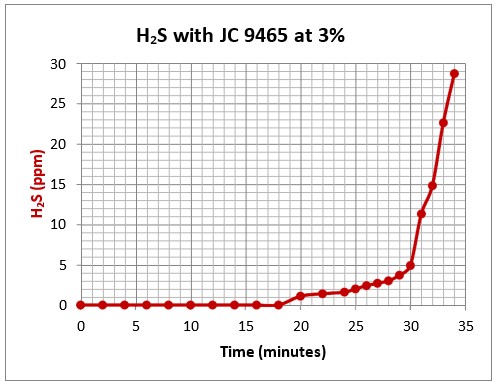
The graph of JC 9465 at 3% demonstrates that 1 mg/l of JC 9465 is required to remove 2.0 mg/l of H2S (by weight). The graph demonstrates that by continuously feeding JC 9465 and maintaining a control range of
+100 mV to +300 mV, the system could achieve optimum H2S removal while being cost effective.
Conclusion
Wet scrubbing can be a cost-effective treatment in a non-regenerative application using JC 9465 as a primary oxidant. JC 9465 is easy to feed and simple to monitor. It is a low-technology solution for removing hydrogen sulfide and carbon dioxide. JC 9465 can be used to treat natural gas, crude oil, refined petroleum products, anaerobic digester gases, flue gases, and others. It is safe to use – non-flammable and non-combustible. It is a part of the new green technology for a safer environment for all.
If you would like more information about JC 9465 and related technology, please contact Jenfitch, Inc. at 925-289-3559.