Taste and odor
Many cyanobacteria produce geosmin and 2-methylisoborneol (MIB), which customers notice at very low levels. Microcystis produces different odor compounds, so identify the organism first.

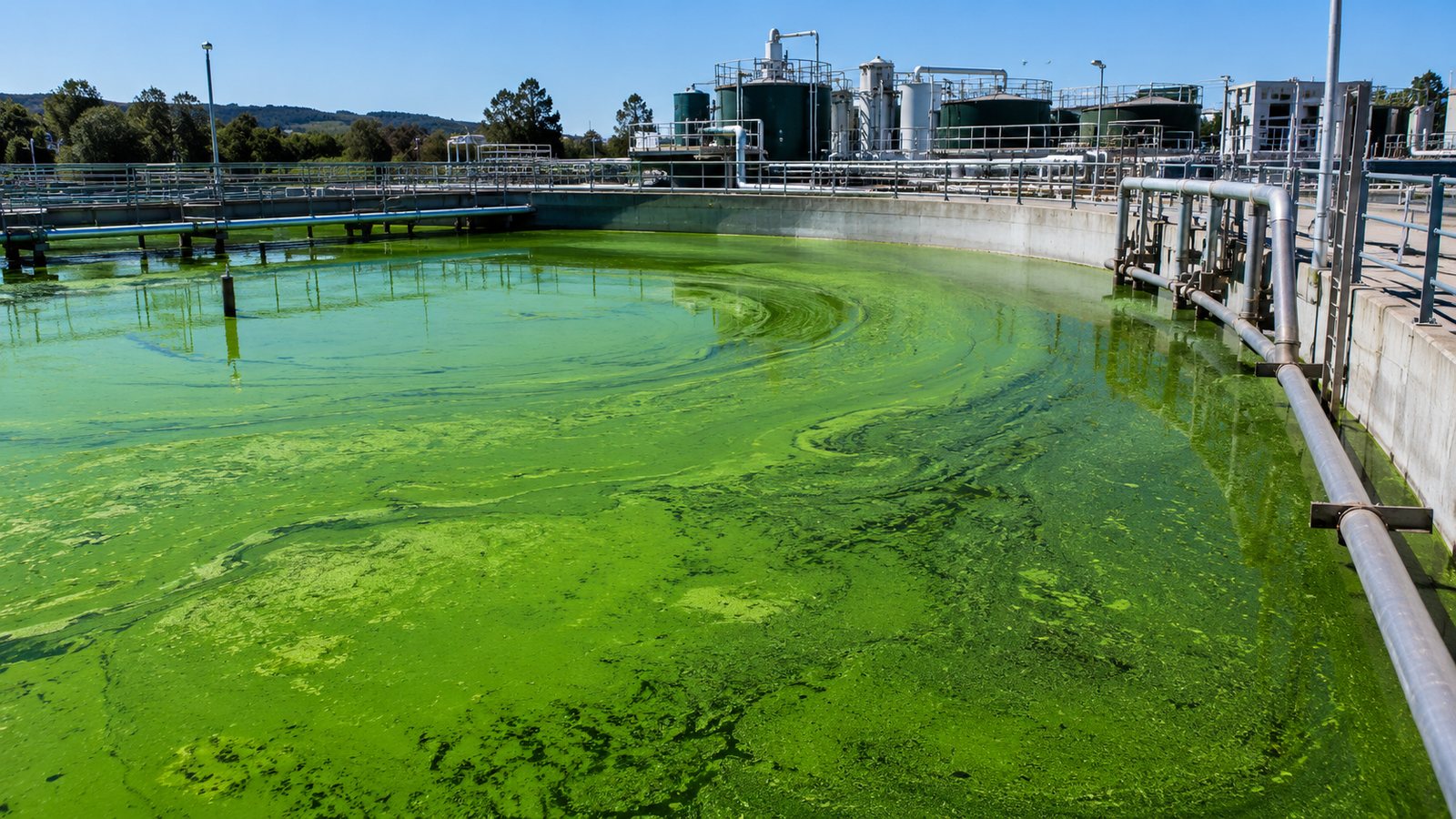
Algae and cyanobacteria in source water drive taste and odor, toxin risk, filter clogging and by-product formation. Here is what NSF/ANSI/CAN 60 certification covers, how the common treatments compare, and where JC 9465 and JC 9450 fit.
An NSF/ANSI/CAN 60 algaecide has been evaluated for the health effects of adding it to drinking water up to a maximum use level; it is not an efficacy test. Jenfitch JC 9465 and JC 9450 are NSF/ANSI/CAN 60 certified with Algicide among their listed functions, at a maximum use of 84 mg/L or 52 mg/L depending on the producing facility. JC 9465 is also EPA FIFRA registered.
Approved, certified & independently validated
 EPA FIFRA
 USDA NOP
 NSF/ANSI
Source Water
Short answer: a bloom in the reservoir becomes a treatment problem at the plant. Algae and cyanobacteria cause taste and odor complaints, can release cyanotoxins, shorten filter runs, and add organic matter that reacts with chlorine to form regulated disinfection by-products.
Many cyanobacteria produce geosmin and 2-methylisoborneol (MIB), which customers notice at very low levels. Microcystis produces different odor compounds, so identify the organism first.
Some cyanobacteria hold toxins inside the cell. EPA favors removing cells intact by coagulation, clarification and filtration, because lysing them releases toxin.
Algal cells load clarifiers and filters: shorter filter runs, more backwashing, higher chemical use, and plugged screens or lost flux on membranes.
Algal organic matter adds to the load free chlorine converts into trihalomethanes (THMs) and haloacetic acids (HAAs). Drought makes this worse, as Goleta Water District found on Lake Cachuma.
Certification
It means the product has been evaluated for the health effects of adding it to drinking water, up to a stated maximum use level. It does not mean the product has been tested for how well it controls algae. Efficacy claims for an algaecide fall under EPA’s pesticide registration program, FIFRA, which is a separate process.
Testing covers regulated metals, radionuclides, organics and other contaminants the formulation could contribute, normalized to the maximum dose, and certified facilities are audited annually. NSF reports that certification is required in most U.S. states and Canadian provinces, and that NSF 60 and FIFRA are independent: neither is a prerequisite for the other. A chemical such as copper sulfate used as an algaecide in drinking water typically needs both. The certifications explained page compares the two in detail.
The NSF listing for Jenfitch, Inc. certifies JC 9465 and JC 9450 as miscellaneous treatment chemicals with functions that include Algicide, Bactericide, Disinfection & Oxidation, Molluscicide, and Corrosion & Scale Control. The maximum use level is 84 mg/L for product from one listed facility and 52 mg/L for product from the other, so confirm the producing facility on the listing before setting a dose ceiling. The listing also carries a monitoring note: finished water must be monitored for residual chlorine species, chlorine dioxide, chlorate, chloramine and disinfection by-products to ensure regulatory compliance.
Options
Short answer: copper algaecides, peroxide-based algaecides, potassium permanganate, chlorine pre-oxidation, ultrasound, and aeration or mixing all have a place. Each trades speed, cost, and side effects differently, and every option that damages cells carries some risk of releasing cyanotoxins during an active bloom.
| Option | Strengths | Limitations |
|---|---|---|
| Copper sulfate / chelated copper | Long track record; low cost; widely available; many products carry both FIFRA registration and NSF 60 certification | Calcium in hard water binds copper; can harm fish in soft or acidic water even at label rates; decaying algae can deplete oxygen; lyses cells |
| Peroxide-based algaecides | Hydrogen peroxide is the active agent; contact action against many planktonic algae | Contact treatment only; not effective on some macroalgae such as Chara and Nitella; oxygen depletion after treatment |
| Potassium permanganate | Familiar pre-oxidant; oxidizes iron, manganese and some odor compounds | Studies cited by EPA show it can release toxins from cyanobacteria cells; overfeed must be avoided |
| Chlorine pre-oxidation | Inexpensive; operators know it well | Reacts with organic matter to form THMs and HAAs; pH-dependent; raises the risk of cell lysis ahead of filtration |
| Ultrasound | No chemical added; collapses the gas vesicles some cyanobacteria use for buoyancy | Results vary by species and site; EPA flags possible cell disruption and toxin release |
| Aeration / mixing | Breaks up the stratification that favors cyanobacteria; cost-effective near the intake | Capital and power cost; slower acting; does not address nutrient loading, the usual underlying cause |
| Mineral oxychloride (JC 9465 / JC 9450) | 2.8–2.9 V oxidation potential; fed to an ORP setpoint; NSF/ANSI/CAN 60 certified with Algicide among listed functions; JC 9465 is EPA FIFRA registered as an algaecide and biocide | An oxidant, so the same cell-lysis caution applies during a toxin-producing bloom; dose capped by the NSF maximum use level; finished-water monitoring per the listing; application governed by the label |
EPA generally discourages algaecide application during a full cyanotoxin-producing bloom, because lysed cells release toxin. Applied very early in the bloom cycle, an algaecide can prevent full proliferation. Sample for cyanotoxins before any application.
Where Jenfitch Fits
They are the same mineral oxychloride chemistry on two registration paths. Both are NSF/ANSI/CAN 60 certified for drinking-water treatment; JC 9465 is also EPA FIFRA registered as an algaecide and biocide. Fed to an ORP setpoint, one oxidant addresses algae, biofilm, iron, manganese and by-product precursors together.
The chemistry releases a family of reactive oxygen species (superoxide, hydroxyl radical, singlet oxygen, hydroperoxyl and peroxide) with an oxidation potential of 2.8–2.9 V, against 2.07 V for ozone and 1.36 V for chlorine. Those species break down the extracellular polymeric substance that holds algae and biofilm to surfaces, which is why Jenfitch treats algae and biofilm as one problem. Details are in JC 9465 as an algaecide and biocide.
Two Goleta details matter for any evaluation. Larger doses removed less TTHM than 5 mg/L, so more product is not automatically better. And the district planned its full-scale test to characterize filter turbidity, algae and pathogen removal, corrosivity and other by-products; those plant-scale results are not in the summary. See Municipal & Utilities and the municipal research library.
Dosing & Monitoring
Short answer: identify the organism and check for toxin first, jar-test a dose series, then pilot on one isolated treatment train with ORP as the control signal. Stay below the NSF maximum use level and monitor finished water for the species named on the listing.
Identify the dominant organism and sample for cyanotoxins before any oxidant goes in. The result decides the dose point, or whether to remove intact cells first.
Simulate the plant on raw water across several doses. Goleta tested five, measuring TOC, iron, manganese, clearwell TTHM and 168-hour TTHM formation potential. Add ORP, turbidity and odor to the panel.
Feed to millivolts rather than a fixed ppm. Jenfitch reference bands run +650 to +750 mV for drinking-water disinfection and 600 to 800 mV for biofilm destruction; the ORP chart lists the rest. The working pH range is 4–9.
Goleta fed one isolated train, kept the others on chlorine in standby, retained chlorine as the final disinfectant, and trended ORP on SCADA so operators could revert within minutes. Installation is a metering pump, a storage tank and an optional ORP controller.
Sample from influent through clearwell for TTHM, TOC, UV absorbance, turbidity, ORP, iron and manganese, plus the chlorine species, chlorate and by-products the NSF listing names. Notify your state drinking-water program before a full-scale test.
Frequently Asked Questions
No. NSF/ANSI/CAN 60 evaluates the health effects of chemicals added to drinking water, including contaminants a product could contribute, up to its maximum use level. It does not evaluate efficacy. Algae-control claims on a pesticide label are reviewed by EPA under FIFRA, a separate program. For a reservoir algaecide in a public water system, look for both and read the label for the approved uses and rates.
The NSF listing shows a maximum use level of 84 mg/L for product made at one listed facility and 52 mg/L for product made at the other, for functions that include Algicide, Disinfection & Oxidation and Molluscicide. Check the current listing on the NSF website and confirm which facility supplied your lot before setting a dose ceiling. Jar testing usually finds an effective dose well below either limit.
EPA generally discourages algaecide application during a full cyanotoxin-producing bloom, because stressed or lysed cells release toxin into the water. Application very early in the bloom cycle can prevent full proliferation. EPA suggests sampling for cyanotoxins first, and the preferred plant strategy is to remove cells intact through coagulation, clarification and filtration. The same caution applies to any strong oxidant, including mineral oxychloride.
That is not how the Goleta Water District evaluation was designed. The district fed JC 9465 as a pre-oxidant in place of sodium hypochlorite at the flash mix and retained chlorine as the final disinfectant to the clearwell. Chlorine remains the standard residual for distribution systems. The goal of pre-oxidation is to remove precursors and reduced metals before chlorine is added.
Goleta's plan sampled from influent through clearwell for TTHM, TOC, UV absorbance, turbidity, ORP, iron, manganese and by-products, with SCADA tracking of filter turbidity, head loss and run time. Add the chlorine species, chlorine dioxide, chlorate and chloramine the NSF listing names for finished water, and odor where taste complaints drive the program.