JC 9465 is an oxidizing biocide that is transforming microbial control for power generation. At a Midwest coal-fired power generation facility, it solved a persistent cooling-water fouling problem that conventional biocides could not.
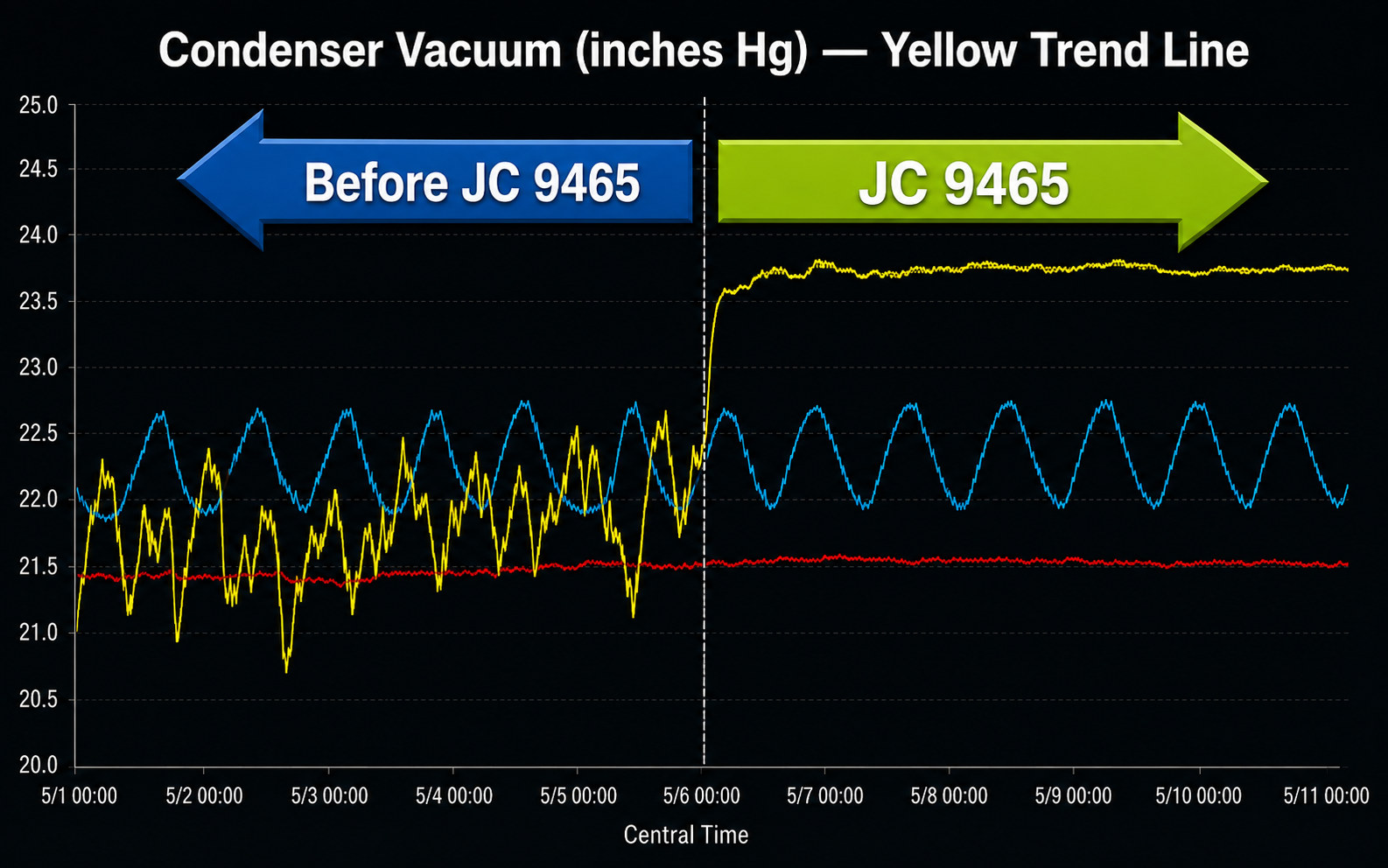
What was the customer challenge?
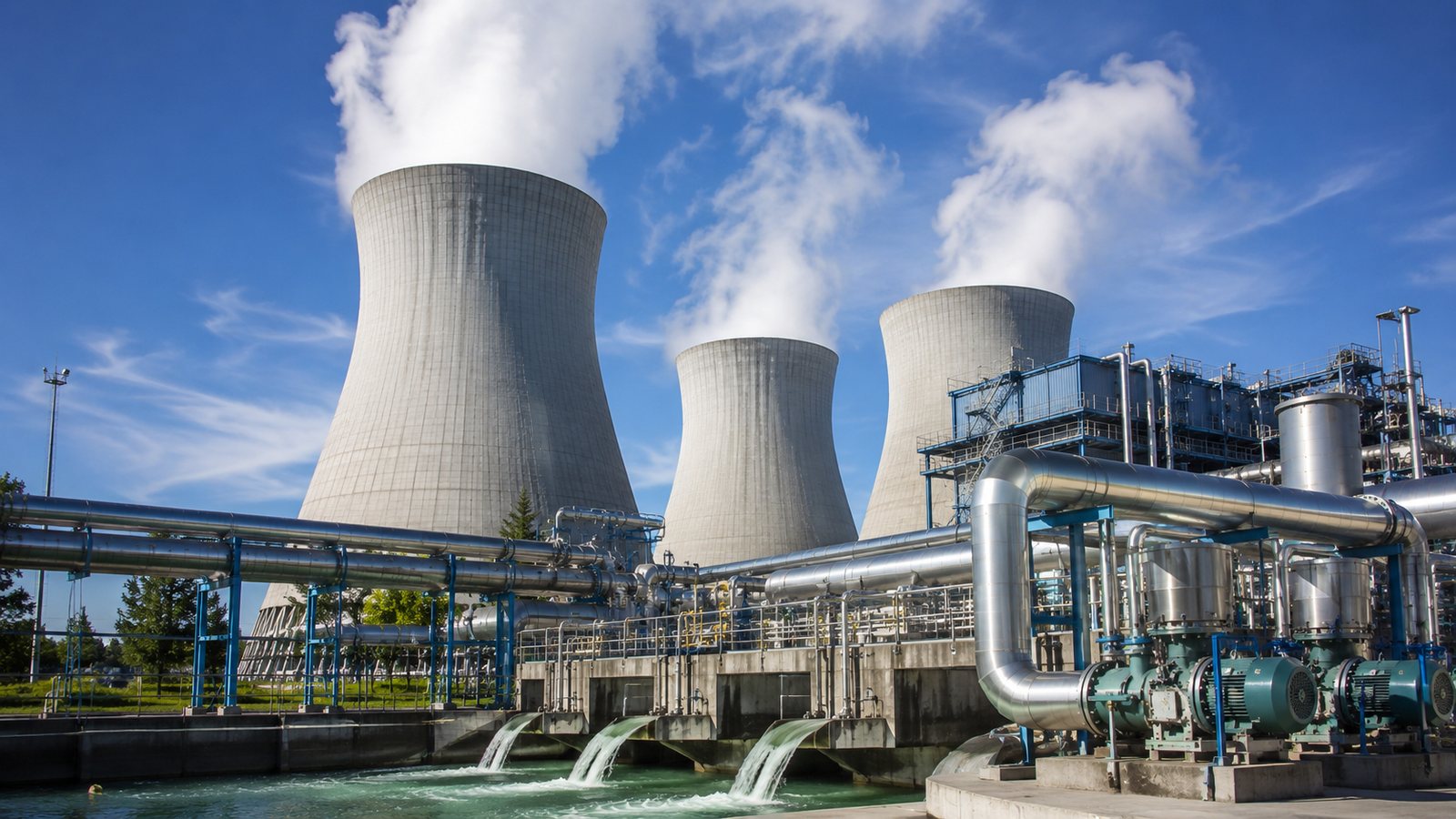
A Midwest coal-fired power generation facility encountered significant challenges in managing microbial growth within the cooling water system. Its reliance on previous biocide solutions, namely sodium hypochlorite, bromine, and mono-chloramine, proved problematic due to the pH-dependent efficiency of sodium hypochlorite, which mandated the addition of sulfuric acid to regulate pH. Additionally, the facility had adopted a competitor's biocide technology based on mono-chloramine, which required on-site generation and led to several months of inadequate treatment.
The consequences were substantial: heightened microbial contamination within the cooling tower, elevated back pressure, decreased operational efficiency, visible microbial fouling, and slime in the condenser head boxes.
Our solution
JC 9465 was proposed for the plant's water disinfection program — a mineral oxychloride biocide supplied as a ready-to-use liquid. JC 9465 stands out with its versatility, effectively operating across various pH levels, making it suitable for seasonal pH fluctuations.
This innovative oxidant offers significant safety and environmental advantages, as it decomposes into harmless byproducts, contributing to enhanced safety and compliance with environmental standards. JC 9465 maintains its effectiveness over an extended period, ensuring consistent microbial control. It is also a cost-effective choice, reducing total operating costs, eliminating the need for capital expenditure, and enabling straightforward monitoring through Oxidation-Reduction Potential (ORP) or chlorine residual measurements.
Proven results
- $88,400 annual savings on sodium hypochlorite
- Eliminated sulfuric acid handling
- 1,827 metric-tons CO2 emissions reduction
- Improved condenser vacuum (1" Hg)
- Overall program cost reduction with improved results
- Enhanced EHS handling and safety
$88,400 annual savings, a 1,827 metric-ton CO2 emissions reduction, and eliminated sulfuric acid handling.
How does JC 9465 generate reactive oxygen species?
JC 9465 is a liquid chelation of minerals with oxygen. The oxygen is weakly bound, so on contact with water the complex releases it, generating a family of reactive oxygen species: superoxide, hydroxyl radical, singlet (nascent) oxygen, hydroperoxyl, and peroxide. Sodium hypochlorite on its own gives hypochlorous acid, hypochlorite ion, and a trace of hydroxyl radical. With the mineral catalyst the same feedstock also yields the mineral complexes that carry the reaction forward, effectively catalytically.
A single-species oxidant has one demand curve — whatever reduces it fastest consumes it first. A mixed ROS population attacks different bonds at once, working organic load, sulfide, iron, and cell walls in parallel. More on the mineral oxychloride chemistry.
Oxidation potential in context
| Oxidant | Potential (V) |
|---|---|
| Fluorine | 3.06 |
| JC 9465 mineral oxychloride | 2.8–2.9 |
| Hydroxyl radical | 2.80 |
| Ozone | 2.07 |
| Chlorine dioxide | 1.57 |
| Chlorine gas | 1.36 |
| Sodium hypochlorite | 0.94 |
Second only to fluorine, on par with the hydroxyl radical itself, and above every halogen in common use. Ozone-class oxidation without dissolving a gas into water.
Why control by ORP instead of ppm?
A ppm figure records how much reagent went in, not how much oxidising work the water can still do. ORP measures the result, and tracks organic load, makeup quality, pH, and cycles without anyone recalculating a dose.
| ORP | Bacteria (CFU / 100 mL) |
|---|---|
| +200 mV | 300 |
| +300 mV | 36 |
| +400 mV | 3 |
| +600 mV | 0 — disinfection |
| +800 mV | 0 — sterilization |
- Routine cooling tower, biofilm and MIC — 400–500 mV
- Biofilm and EPS destruction — 600–800 mV
- Disinfection barrier — 650–750 mV
- Sterilization — above 800 mV
At +700 mV, a 6-log reduction in under 10 seconds. Full targets are on the ORP reference chart.
How are biofilm and EPS destroyed?
The extracellular polymeric substance a colony secretes is a hydrated gel that spends oxidant at its outer face, so a bulk-water residual never reaches the cells underneath. That is how plate counts and free-chlorine readings both look acceptable while the condenser keeps losing vacuum.
Held in the 600–800 mV band, hydroxyl radicals break down the EPS matrix first and the remaining species oxidise cell walls and bacterial DNA, so the film releases rather than being disinfected on its surface. Drop back to 400–500 mV once it does. See how JC 9465 removes biofilm.
Residual, shelf life, and installation
Ozone matches JC 9465 for oxidising power in the contact chamber and then it is gone — generated on site, consumed where it is made, nothing holding the system downstream. Mineral oxychloride leaves mineral-oxide by-products that are themselves mildly biocidal and below FDA limits, so treated water resists recontamination. See our comparison with ozone.
Shelf life is six months against roughly 30 days for sodium hypochlorite, which loses strength quietly; a fixed-ppm program fed from an aging drum under-treats without showing it on the log sheet. Dosing rules of thumb:
- Inorganics — under 1.0 mg/L per 1.0 mg/L of contaminant; chlorine needs about 6
- Pathogens — 1.0 mg/L per 1,000–10,000 mg/L of organism load
- Organics — 1.0–8.0 mg/L per 1.0 mg/L of contaminant
Working pH is 4–9. A typical installation is a metering pump, a storage tank, and an optional ORP controller on the existing loop — no on-site generation, no capital plant. See Industrial & Cooling Towers.
Frequently asked questions
What is the oxidation potential of JC 9465?
JC 9465 carries an electrochemical oxidation potential of 2.8–2.9 V. That is second only to fluorine at 3.06 V, on par with the hydroxyl radical at 2.80 V, and above ozone at 2.07 V, chlorine dioxide at 1.57 V, chlorine at 1.36 V, and sodium hypochlorite at 0.94 V.
Why dose an oxidising biocide to ORP instead of ppm?
A ppm figure records how much reagent was added, not how much oxidising work the water can still do. ORP measures the result, so it moves with load and water quality on its own. Surviving counts track it closely: 300 CFU per 100 mL at +200 mV, 3 at +400 mV, none at +600 mV.
Does JC 9465 leave a residual, or dissipate like ozone?
It leaves one. Ozone is consumed where it is generated and holds nothing downstream. Mineral oxychloride leaves mineral-oxide by-products that are themselves mildly biocidal and fall below FDA limits, so treated water resists recontamination — which is what makes it workable in a recirculating loop.
What ORP setpoint should I run for biofilm control?
Run 400–500 mV for routine biofilm and MIC control. For a cleanup pass on a loop with an established film, step up to the 600–800 mV band until the film releases, then drop back to the maintenance setpoint. A disinfection barrier is held at 650–750 mV.
How long does JC 9465 keep, and what does feeding it require?
Shelf life is six months against roughly 30 days for sodium hypochlorite. It is a ready-to-use, water-soluble liquid effective across pH 4 to 9. A typical feed system is a metering pump, a storage tank, and an optional ORP controller on the existing loop.
Have a water challenge like this?
Talk to Jenfitch about JC 9465, safety data sheets, or scoping a treatment program for your facility.