Contact time in seconds
At +700 mV, UC Davis Post-Harvest measured a 6-log CFU reduction in under 10 seconds on E. coli, Listeria and Salmonella. That fits inside the dwell time a dump tank or flume already provides.

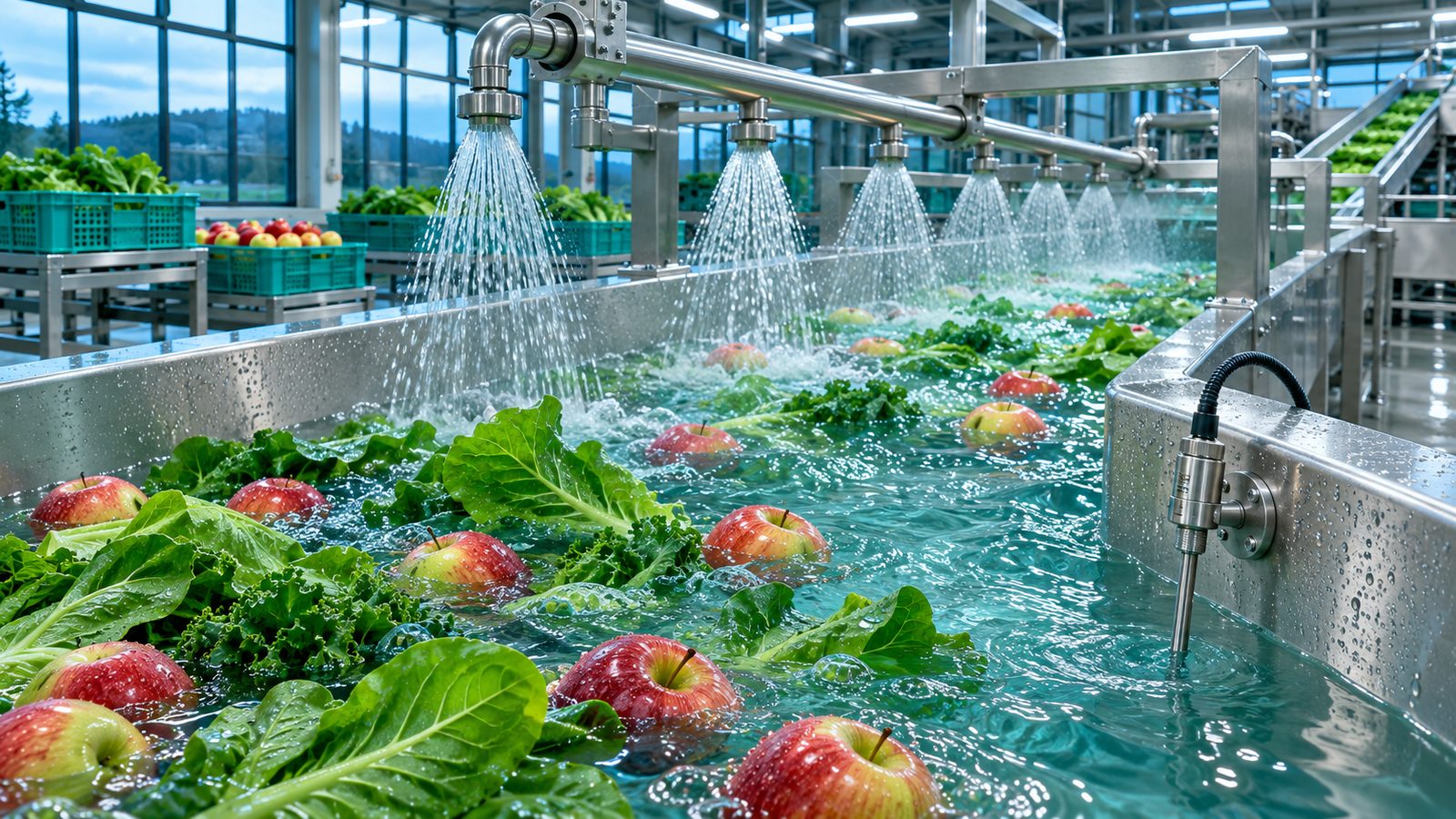
Wash water is where one contaminated lot reaches the rest. Here is what the National List and FSMA expect of post-harvest water, and how JC 9465 fits an organic program.
USDA NOP allows chlorine materials, hypochlorous acid from electrolyzed water, peracetic acid, hydrogen peroxide and ozone in organic wash water, each under its annotation; chlorine contact water must be followed by a potable rinse at or below 4 mg/L. JC 9465 is EPA FIFRA registered, allowed for organic production under USDA NOP (WSDA-listed), and its labeled uses include post-harvest facility processing.
Approved, certified & independently validated
 EPA FIFRA
 USDA NOP
 NSF/ANSI
The Risk
Short answer: because every lot shares the same water. One contaminated bin can seed the dump tank, and the tank can seed every clean lot behind it. A sanitizer in the water is there mainly to stop that water-to-produce and produce-to-produce transfer, not to sterilize the produce surface.
The transfer is measurable. In a peer-reviewed study published in Frontiers in Microbiology in 2020, a single Listeria monocytogenes-inoculated apple washed in plain water with ten clean apples transferred about 3.8 log10 CFU per apple, and all ten clean apples tested positive. Washing in a sanitizer solution changed that outcome entirely, as described below.
Recirculated water makes the problem worse through the shift. Flumes and hydro-coolers accumulate soil, plant debris and sugars, and that load consumes oxidant continuously, so a dose that worked at the start of the day can fall short by mid-afternoon. Ice made from untreated water carries the same risk into transport. Jenfitch maps these points in improving food safety and quality.
FSMA
For covered produce, water used in harvest and post-harvest activities must have no detectable generic E. coli in 100 mL, and farms must manage, monitor and, where treated, verify it. The rule does not name a required sanitizer, but treatment it relies on must be effective and monitored.
FDA summarizes these requirements on its harvest and post-harvest agricultural water page.
USDA NOP
Short answer: the National List allows chlorine materials, hypochlorous acid from electrolyzed water, peracetic acid, hydrogen peroxide and ozone in organic handling, each subject to its annotation and to FDA or EPA limits for the use. Chlorine carries the strictest condition: product contact water must be followed by a potable rinse at or below the drinking-water limit.
| Material | National List entry | Key condition for wash water |
|---|---|---|
| Chlorine materials (calcium hypochlorite, sodium hypochlorite, chlorine dioxide) | 205.605(b)(12) | Per NOP 5026, product contact water may hold chlorine at levels FDA or EPA approve for the use, followed immediately by a potable-water rinse that does not exceed the Safe Drinking Water Act maximum residual disinfectant limit: 4 mg/L as Cl2 (0.8 mg/L for chlorine dioxide). The certified operation should monitor chlorine in the final rinse. |
| Hypochlorous acid from electrolyzed water | 205.605(b)(12)(iii) | Listed as a chlorine material, so the same final-rinse condition applies |
| Peracetic acid (PAA) | 205.605(b)(22) | For use in wash and/or rinse water according to FDA limitations; also a food-contact surface sanitizer |
| Hydrogen peroxide | 205.605(b)(17) | No annotation; product label and FDA limits govern |
| Ozone | 205.605(b)(21) | No annotation; generated on site |
| Mineral oxychloride (JC 9465) | Allowed for organic production under USDA NOP (WSDA-listed) | EPA FIFRA registered; labeled uses include post-harvest facility processing, and the label governs rates and directions |
An organic allowance says a material may be used in a certified operation. It does not replace the EPA registration or FDA clearance that sets how much may be used and how. Each sanitizer still has to be used according to its label and the conditions on its listing.
Monitoring
A ppm reading records how much sanitizer went into the tank; ORP measures how much oxidizing power the water still has. Organic load and pH both change that power through a shift, so two tanks logged at the same ppm can deliver very different microbiology. A controller that trims feed to a millivolt setpoint follows the real demand.
Jenfitch’s reference benchmark ties surviving counts to ORP: about 300 CFU/100 mL at +200 mV, 36 at +300 mV, 3 at +400 mV, and none at +600 mV. The working band for in-field and post-harvest disinfection is +650 to +750 mV. The full table is on the ORP reference chart.
Continuous ORP logging gives a packing house the treatment-monitoring record that 112.46 calls for, alongside the visual checks, temperature readings and water-change schedule that 112.44(d) requires. Keep the logs with your organic records so the same data answers both the food-safety auditor and the certifier.
Where JC 9465 Fits
Short answer: JC 9465 is a mineral oxychloride sanitizer that is EPA FIFRA registered, NSF/ANSI/CAN 60 certified, and allowed for organic production under USDA NOP (WSDA-listed), and its labeled uses include post-harvest facility processing. Fed to an ORP setpoint, one chemistry serves dump tanks, flumes, hydro-coolers and ice water for organic and conventional lots.
At +700 mV, UC Davis Post-Harvest measured a 6-log CFU reduction in under 10 seconds on E. coli, Listeria and Salmonella. That fits inside the dwell time a dump tank or flume already provides.
In the 2020 Frontiers in Microbiology apple study, which tested JC 9450, the same mineral oxychloride chemistry, no Listeria was detected on any clean apple after a 2-minute wash, and pathogen in the spent wash solution fell below the detection limit.
In the same JC 9450 study, the highest dose cut Listeria on apples by 3.84 log10 CFU per apple after a 2-minute wash, against 1.15 for chlorine at about 110 ppm free available chlorine.
Because JC 9465 is allowed on both sides, a mixed packing house can run organic and conventional lots through the same tank at the same setpoint, with no drain-and-flush changeover and one set of records.
Shelf life is the secondary return. In a Jenfitch demonstration, grocery-store raspberries rinsed once with JC 9465 showed their first mold on day 18, while the untreated control began molding by day 12. The approvals behind this are covered in JC 9465 EPA and USDA organic approval, and the wider program on the Food & Agriculture page. For how mineral oxychloride compares with other wash oxidants, see mineral oxychloride vs. peracetic acid and vs. hydrogen peroxide.
Getting Started
Short answer: clear the material with your certifier first, then set up feed and monitoring at the highest-risk transfer point. Keep the label and listing on file before the first lot goes through.
Ask your certifier to approve JC 9465 for post-harvest wash water and add it to your organic system plan. Ask whether they expect a potable rinse or any other condition.
Hold the current JC 9465 label, SDS and WSDA listing with your organic records. Request the label and SDS from Jenfitch.
Every lot passes through it. Add flumes, hydro-coolers and ice-making water next. Installation is a metering pump, a storage tank and an optional ORP controller.
Feed to the +650 to +750 mV band within label rates, log ORP continuously, and keep the FSMA water-change, visual and temperature records alongside.
Frequently Asked Questions
Yes, with a condition. Chlorine materials are listed at 7 CFR 205.605(b)(12). Under NOP Guidance 5026, water in direct post-harvest contact may hold chlorine at levels FDA or EPA approve for that use, but a potable-water rinse that does not exceed the federal drinking-water limit of 4 mg/L as chlorine must immediately follow. The certified operation should monitor the chlorine level of that final rinse.
Not by name. It requires that post-harvest water contacting covered produce have no detectable generic E. coli in 100 mL, that recirculated water be managed with change schedules, visual checks and temperature control, and that any treatment be effective and monitored. A sanitizer fed to a monitored setpoint is a common way to meet those requirements and limit cross-contamination.
No. The peer-reviewed study published in Frontiers in Microbiology in 2020 tested JC 9450, which is the same mineral oxychloride chemistry as JC 9465. For organic post-harvest wash water, JC 9465 is the product that is EPA FIFRA registered and allowed for organic production under USDA NOP, so it is the one to specify and use according to its label.
Keep the current product label, the SDS, and the WSDA Organic Input Material List entry, along with your certifier's approval and the organic system plan that lists the input. Add ORP logs and the FSMA water records. Jenfitch provides the label and SDS on request through the contact page.
Yes. Peracetic acid is listed at 7 CFR 205.605(b)(22) for use in wash and/or rinse water according to FDA limitations, and as a sanitizer on food-contact surfaces. As with any sanitizer, the product label and FDA limits set the concentration, and your certifier confirms the specific product before use.
Yes, if it is allowed for organic production and registered for the use. Because JC 9465 is both EPA FIFRA registered and allowed under USDA NOP, a mixed packing house can run organic and conventional lots through the same tank at the same ORP setpoint, without a chemistry changeover or drain-and-flush between runs.